



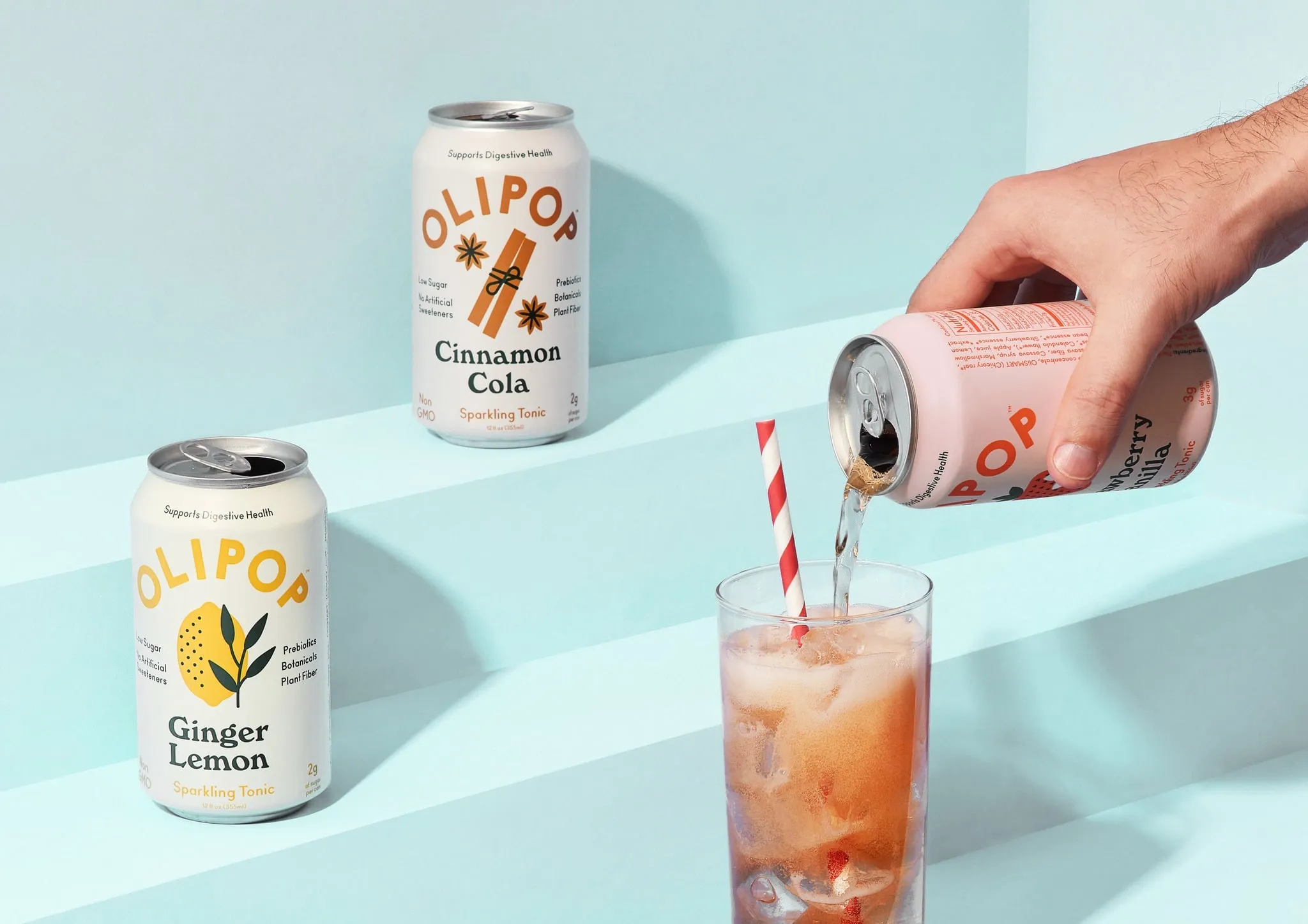
Olipop, the maker of prebiotic soda, is on track to surpass $200 million in annual sales this year, only five years after hitting grocery store shelves.
Beverage behemoths PepsiCo and Coca-Cola have already knocked, according to founder and CEO Ben Goodwin. But he’s not ready to cash out just yet.
“Right now, my focus is on blowing business through the roof,” Goodwin said to Trade Algo.
Coke and Pepsi did not reply to requests for comment.
This year, Olipop expects to more than treble its revenues. The business presents itself as a healthier alternative to regular Coke while maintaining the same recognizable flavor.
According to Pitchbook statistics, as of Jan. 2, Olipop has raised $55.4 million at a stated valuation of $199.8 million. Gwyneth Paltrow, former PepsiCo CEO Indra Nooyi, and RXBAR creator Peter Rahal are among the investors.
Goodwin thinks that 10% of Olipop consumers have completely replaced conventional soda, with the remainder incorporating it into their routines regularly.
“We are replacing that soda experience and soda occasion,” Goodwin explained.
Soda consumption in the United States has been declining for nearly two decades. Because of worries about soda’s sugar — or sugar substitutes such as aspartame — Americans have switched to bottled water, flavored seltzer, and other healthier choices. Nonetheless, Coke and Pepsi are not in danger of discontinuing their respective sodas.
“Consumers are drinking less soft drinks, but they’re still drinking a lot of soft drinks,” said Michele Scott, Mintel’s associate director of food and drink research in the United States.
Consumers are also becoming more interested in “gut health,” which is one of the most recent wellness trends. According to Matthew Barry, Euromonitor International’s insights manager for food and drinks, the two trends — the decrease in soda and the growth of gut health — have aided Olipop and other comparable companies such as Poppi.
According to SPINS statistics, functional soda represents for 14% of the digestive health category.
Olipop’s recipe contains nine grams of fiber and prebiotics, which are compounds that aid in the growth of good bacteria in the stomach. Their health benefits have not been proven.
Poppi, a competitor created in 2015 that has seen its sales increase in the last year, infuses its soda with apple cider vinegar, which includes prebiotics. Olipop and Poppi have both pushed towards TikTok influencer marketing, where gut health became a trendy subject last year.
According to Goodwin, Olipop’s root beer surpassed Keurig Dr. Pepper’s A&W as the best-selling root beer at an unidentified prominent U.S. retailer in February. He sees it as another indication of Olipop’s potential, as root beer was one of the first flavors it sold.
“I hope that as other [flavors] in the system mature and gain greater distribution and customer familiarity, we will be able to replicate this type of story with a variety of different flavors,” he added.
Goodwin claims he invented the root beer and is still the company’s top formulator, relying on his “super tasting” abilities due to taste receptors that are more sensitive than the normal person’s.
He dropped out of college at the age of 20 to assist his pals in launching a kombucha firm. Following that, he co-founded Obi probiotic soda with Olipop co-founder and Diageo executive. David Lester is an alumnus. Obi was sold in 2016. The next year, they began working on Olipop’s recipe.
Despite its success, Olipop is still in its early phases of expansion, with only 20,000 retail outlets and 12 varieties. It began at natural food retailers in the Bay Area and has now extended to mainstream companies such as Target and Kroger. According to Goodwin, the company’s development in the Midwest contributed to its record sales last year.
Olipop’s increasing sales have corresponded with soaring grocery store costs. According to Labor Department data, the price index for food at home climbed 8.4% in March compared to the previous year.
Coca-Cola and Pepsi have boosted their prices by double-digit percentages in the last year, claiming that the increases are necessary to combat inflation. Reactions to the duopoly have been divided.
Pepsi’s North American beverage division saw volume dip 2% in the first quarter, while Coke’s North American beverages segment reported stable volume.
Despite the increasing pricing of Coke and Pepsi, Olipop is still the more expensive option. In New York City, a 12-ounce can of Olipop costs $2.49, which is the same price as a 20-ounce bottle of Pepsi.
“The challenge for Olipop and beverages like it right now is the premium price point during a time of inflation,” said Euromonitor’s Barry. “There is undoubtedly a group of consumers who can afford to buy high-priced sodas regularly, but this is a small subset of the population.”
However, Olipop’s Goodwin believes that consumers are willing to pay more for the drinks he creates. He claims that soda is only second to coffee in terms of price inelasticity, implying that customers are prepared to spend more.