








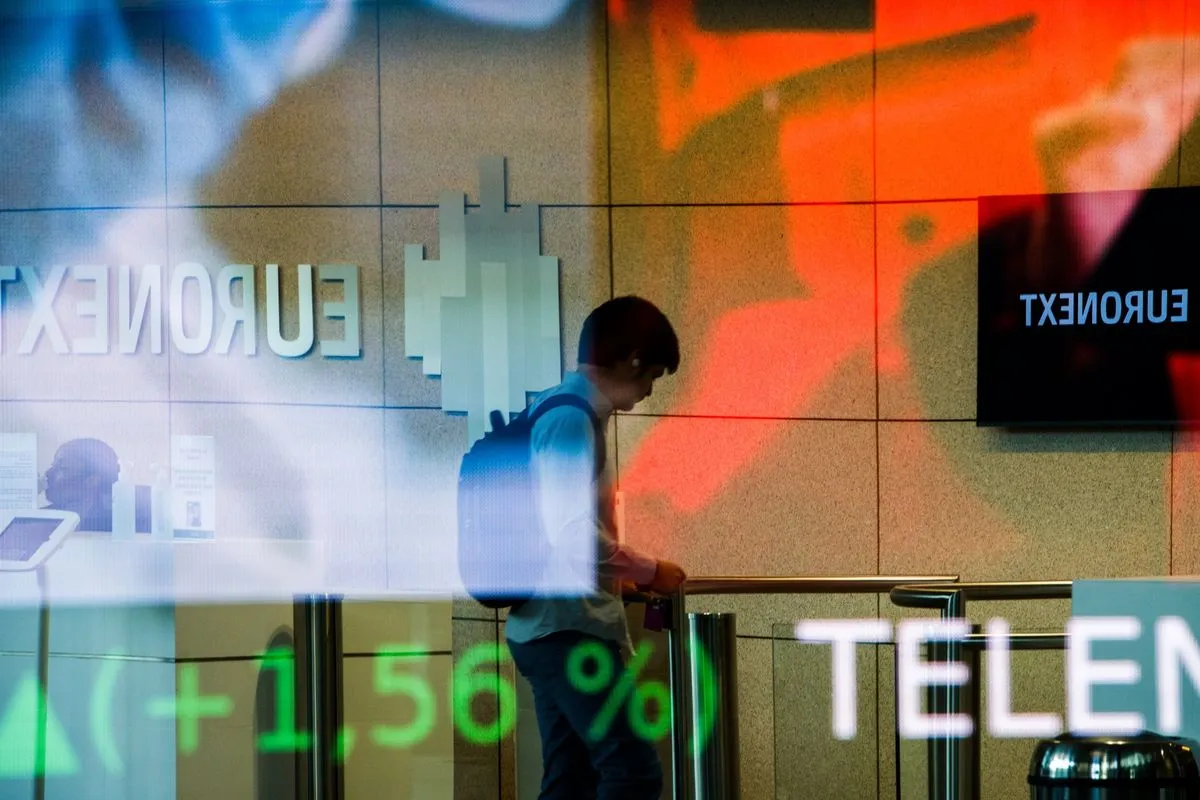
Despite the prospects for global recession, European markets advanced on Friday as investors hoped for a Chinese economic recovery as Covid-19 curbs are eased.
As of early afternoon, the Stoxx 600 index was up 0.5%, with construction and material stocks adding 1.3%. Oil and gas stocks pared earlier losses but remained down 0.2%.
The U.S. Federal Reserve and Bank of England will hold their next monetary policy meetings next week, following a relatively muted week for European stock markets.
Although investors are increasingly concerned about whether the Fed will be able to avoid a recession next year by raising interest rates by 50 basis points – smaller than the previous four increments of 75 basis points.
Hong Kong’s Hang Seng index led gains overnight, as Chinese inflation data came in roughly in line with expectations. According to state media, Chinese Premier Li Keqiang said the country’s easing of Covid policy would boost the economy. As traders anticipate fresh wholesale inflation data due later in the day, U.S. stock futures were modestly higher in early premarket trade on Friday.
Oil and gas stocks in Europe fell 0.8% in early afternoon trading, while all other sectors were up.
The West Texas Intermediate crude and Brent crude futures both rose on the day, but will lose around 10% each on the week. This is the worst weekly drop since April and August, respectively.
As the EU, along with the G-7 and Australia, imposed a price cap on Russian seaborne oil, this week saw the start of the EU’s embargo on Russian crude oil purchases.
Despite increased demand in China and a Turkish tanker bottleneck, the easing of Covid-19 restrictions failed to boost oil prices significantly.
At 1 p.m. in London, Totalenergies was down 1.8%, Shell was down 0.8%, and BP was down 1.3%.
Financial Conduct Authority fined Spanish bank Santander £107.7 million ($132 million) for “serious and persistent” failures.
Between Dec. 31, 2012 and Oct. 18, 2017, Santander’s U.K. arm failed to properly oversee its anti-money laundering systems for more than 560,000 business customers.
The new customer opened an account with an expected monthly deposit of 5,000 pounds as a small translation business.
”The FCA received millions of pounds in deposits within six months, and swiftly transferred the funds to separate accounts,” said Mark Steward, FCA executive director for enforcement.
Friday, the U.K. government announced extensive financial regulation reforms that it said would overhaul EU laws that “choke off growth.”
Among the 30 measures is a relaxation of the rule that requires banks to separate their retail operations from their investment arms. Originally enacted after the 2008 Financial Crisis, this measure would not apply to retail-focused banks.
Among other topics, Henry Dixon of Man Group discusses the outlook for earnings in 2023 and the U.S. labor market. A weak profit outlook for the first quarter sent Carl Zeiss Meditec shares tumbling more than 10% in early trade. British investment manager Man Group climbed 4.7% after announcing a $125 million share buyback program at the top of the European blue chip index.
Germany’s DAX is expected to rise around 54 points to 14,319, while France’s CAC 40 is expected to rise around 21 points to 6,668.
Steven Lynch, managing director of the British Chamber of Commerce in China, says Beijing’s “U-turn” on Covid policies has left both confused and optimistic.
According to him, “There is a lot of optimism and hope for 2023, but there is a lot of confusion,” he told CNBC’s “Squawk Box Asia.”
According to him, there are still “enormous inconsistencies” between local policies and central government regulations.
The one thing that is very clear is that Covid is now here. Covid is pretty prevalent here in Beijing, and I think that brings with it a whole new set of challenges for China.
According to Bank of America, a shortage of semiconductors during an electric-vehicle boom could increase profits for chip makers.
As a result of this trend, two chip stocks could see their share prices rise by more than 75%. Despite rising interest rates, and other headwinds, tech companies have had a tumultuous year. Despite some headwinds, Apple has held up better amid the tech carnage.
CNBC’s “Street Signs Asia” featured two investors arguing for and against buying the stock on Wednesday.